
loader image

Publications

sustainability 18 00950 g007

A Supply Chain Analysis on Natural Rubber in Industrial Solid Tire Manufacturing Based on a Social Life Cycle Assessment Method: A Case Study Under Sri Lankan Scenario

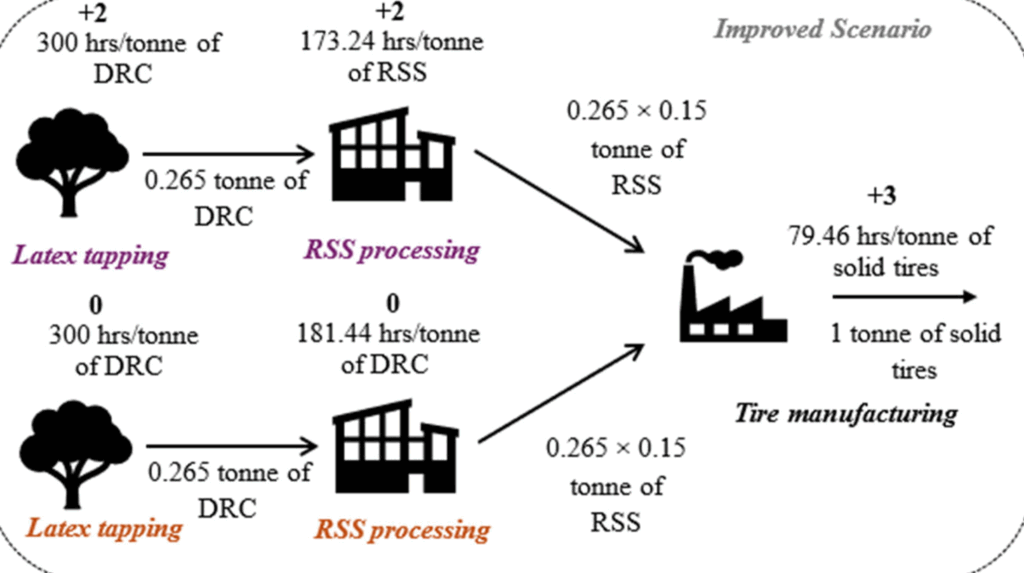
Abstract : As the largest exporter in the global solid tire market, Sri Lanka’s natural rubber supply chain plays a critical role in global production, yet its social dimension remains largely unaddressed. Our study aims to assess the social performance of a Sri Lankan natural rubber supply chain in solid tire manufacturing using social life cycle assessment (S-LCA) in a cradle-to-gate approach. Study adapts “More Good and Less Bad” method which captures both positive and negative social impacts, addressing traditional S-LCAs’ focus on negative impacts solely. It applies to updated methodological sheets to distinguish “good” and “bad” social conditions across subcategories based on baseline compliance. Social impacts were quantified using a Social Performance Index (SPI), calculated by multiplying social performance levels by working hours at the organizational level, comprising SPIgood for good social impacts and SPIbad for bad social impacts. Data was collected through stakeholder interviews, with working hours calculated using a “working hour model”. Results showed mixed social performance across 39 subcategories, identifying six social hotspots: promoting social responsibility (27.67% less bad, 72.32% more good), wealth distribution (26.87% less bad, 73.13% more good), commitment to sustainability issues (100% less bad), social benefits (100% less bad), safe and healthy living conditions (100% less bad), and hours of work (88.74% less bad, 11.26% more good). DOI : https://doi.org/10.3390/su18020950
A Supply Chain Analysis on Natural Rubber in Industrial Solid Tire Manufacturing Based on a Social Life Cycle Assessment Method: A Case Study Under Sri Lankan Scenario Read More »

resources 14 00172 g001

Assessment of Organizational Carbon Footprints in a Rubber Plantation Company: A Systematic Approach to Direct and Indirect Emissions

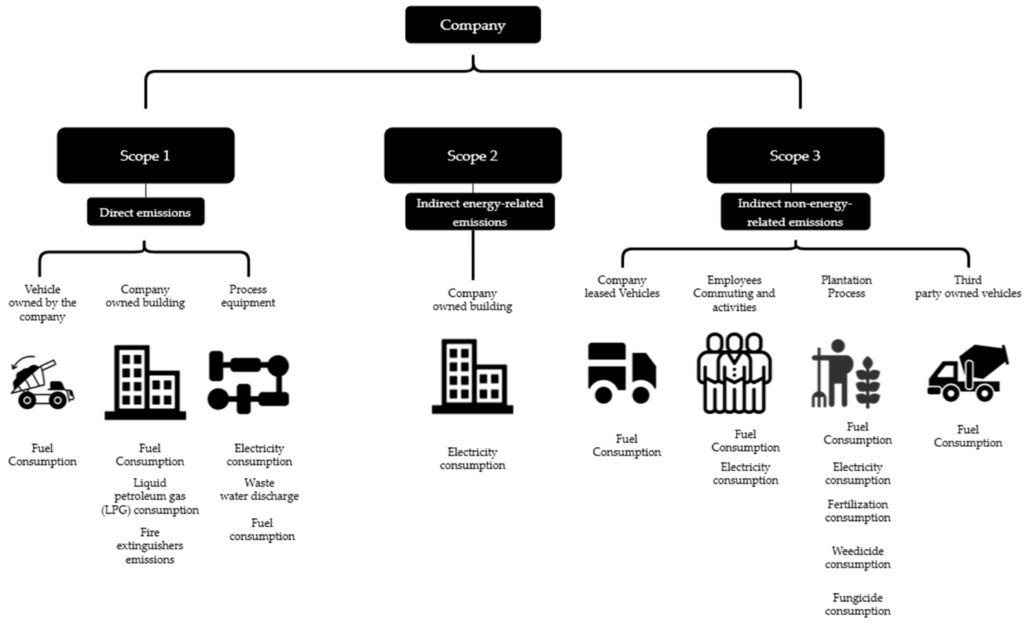
Abstract : This study presents a comprehensive organizational carbon footprint assessment that integrates Scope 1, 2, and 3 emissions for a rubber plantation company, including often-overlooked non-energy sources such as fertilizer application, employee commuting, company-owned vehicle operations, and wastewater discharge. Using the Greenhouse Gas Protocol standard, IPCC 2006 guidelines, and locally adapted emission factors, the assessment quantified the company’s total organizational carbon footprint at 3125 tCO2e—revealing a previously undocumented emission profile where methane from wastewater discharge, nitrous oxide from fertilizer application, and carbon dioxide from purchased electricity collectively account for over 75% of total emissions. This finding challenges conventional rubber industry practice, which has historically focused on energy-related emissions alone. Three targeted mitigation scenarios were evaluated: (1) optimized nutrient management to reduce fertilizer usage, (2) solar photovoltaic installation to offset grid electricity consumption, and (3) advanced wastewater treatment using Fenton’s reagent combined with activated carbon. Results demonstrate that substantial emission reductions are achievable while maintaining or enhancing productivity and profitability. By establishing a replicable methodological framework grounded in comprehensive emission accounting, this study advances environmental management practices in the rubber sector and provides actionable strategies for plantation-based industries to meet national sustainability agendas and international climate commitments. DOI : https://doi.org/10.3390/resources14110172

Assessment of Organizational Carbon Footprints in a Rubber Plantation Company: A Systematic Approach to Direct and Indirect Emissions Read More »

sustainability 17 04830 g002

Social Life Cycle Assessment Methodology to Capture “More-Good” and “Less-Bad” Social Impacts—Part 1: A Methodological Framework

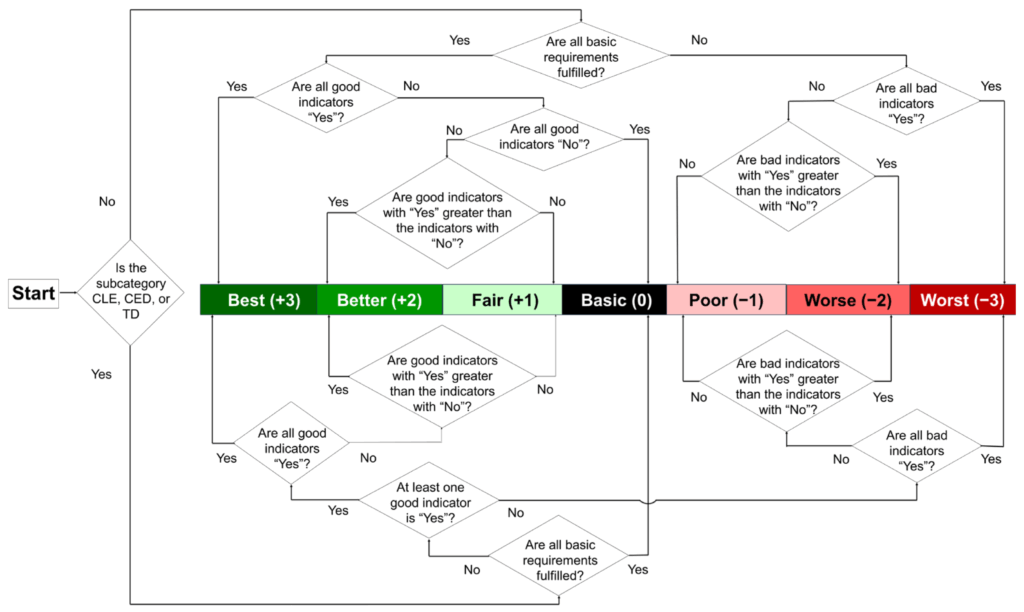
Abstract : Social life cycle assessment (SLCA) systematically assesses the social impacts of the entire life cycle of a product system or service that stretches from extraction and processing of raw material to recycling and final disposal. Most SLCA techniques highlight negative impacts and their reductions, while positive social impacts and their increments have received less attention. Positive social impacts highlight chances for improving human well-being and present a complete picture of a product’s overall social impact. The literature shows that norms for defining positive impacts and methodologies for assessing them are not yet fully established and retain lacunae, which can lead to conflicts in the usage of the term “positive impacts”. Therefore, we develop a novel SLCA methodology that can straightforwardly distinguish between the “good” and “bad” social state at the subcategories in the latest version of methodological sheets for SLCA. Here, we refrain from using the terms “positive” and “negative” as those terms retain scattered consensus; instead, we use the fresh terms “good” and “bad”, which are simpler to understand. To describe the positive changes in good and bad states, we introduce two new terms into SLCA: “more-good” (improvements within the good domain) and “less-bad” (improvements within the bad domain). Good and bad social domains are distinguished using compliance levels (e.g., industry standards), referred to as baseline requirements. Social impacts were evaluated using the social performance index (SPI). The SPI is computed by multiplying social performance levels with working hours at the factory/company level. Social performance levels are evaluated using a decision tree and a systematically proposed set of indicators representing basic requirements and good and bad domains of each subcategory. Working hours were used as an activity variable, estimated using a working hour model. This enables the application of the SPI across the supply chain of a product by linking social impacts to the time spent on each activity. DOI : https://doi.org/10.3390/su17114830

Social Life Cycle Assessment Methodology to Capture “More-Good” and “Less-Bad” Social Impacts—Part 1: A Methodological Framework Read More »